
Mystery · AL-19-440
Ashford Lake: The Midnight House
The sheriff likes a fall against the hearth. The dock remembers a boat.
Friday, 18 October, first frost · Midnight House, Ashford Lake — a private water on the fictional Meridian Range
Crime Talk
Scott Reisch
Host of Crime Talk
I host Crime Talk. This file is not one of ours from the courthouse. Ashford Lake, Midnight House, Harlan Crowe, and every guest are invented. The habit is not. A sheriff can like a fall against a hearth because it is a complete sentence. Your job is to see whether the dock, the clock, and the safe will say the same sentence. If they will not, the tidy story is not the case. Treat the clues as if a jury could only use what you can point to.
Friday, 18 October. First frost on a private lake in the fictional Meridian Range. Midnight House is shut for the night with six guests and Harlan Crowe, who retired from touring illusions and stayed in the business of rare paper.
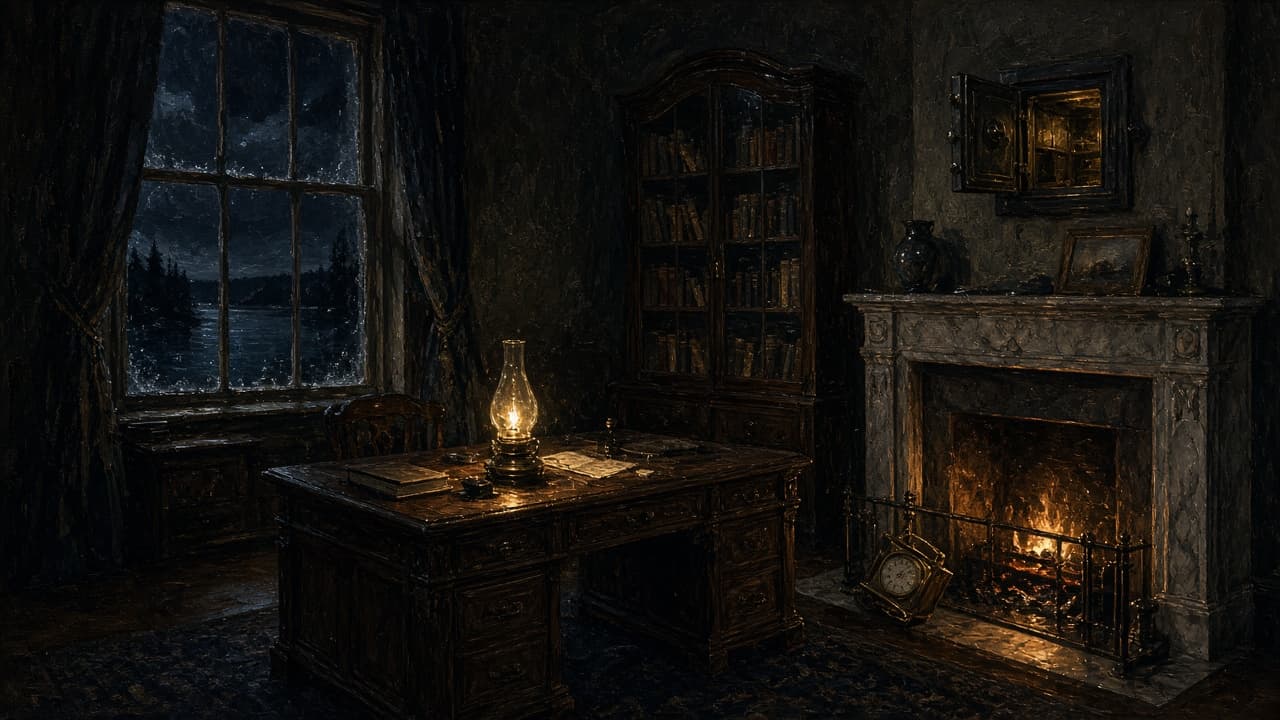
Shortly after one, the housekeeper finds him in the study. The county’s first note calls it an accidental fall against the marble hearth after a last whiskey. His estranged spouse, Ivy Crowe, still inherits under the old will. The sheriff likes that story.
You are retained by the defense. Search the rooms. Interview everyone. The questions that matter open when you can put a clue on the table. When the path is unique, file a charge: who, how, why, and two or three pieces that carry it.
How to playShowHide
Name who did it, how, and why, and back the charge with evidence from the house.
Step 1
Search the rooms
Examine the spots in each room.
Step 2
Question the guests
Ask what they will answer.
Step 3
Build the evidence board and the timeline
Pin what matters, and put the night in order.
Step 4
Make your accusation
Name who, how, and why, then file the pieces that carry it.
Locked questions
Some questions are marked Locked. A locked question stays shut until you have found the clue it needs, or until you have already heard another answer it depends on. The note under the question says what is missing. Once you have that, the question unlocks. Leaving a question locked does not cost points.
How scoring works
You start at 1,000. The score cannot go below 0 or above 1,100. With no hints and no missed charges, a solved timeline scores 1,050.
| Start | 1,000 |
|---|---|
| Each hint | −60 |
| Each wrong charge | −120 |
| Each half-right charge | −40 |
| Timeline in order | +50 |
| Rookie | 0–399 |
|---|---|
| Investigator | 400–649 |
| Detective | 650–849 |
| Lead Detective | 850 and up |
A charge is right when the person, the method, and the motive are all right, and at least 2 of the pieces you file support it. You file 2 or 3 pieces. A right charge does not cost points.
A charge is half-right when you name the right person, or you name both the right method and the right motive, but the charge is not fully right. Each half-right charge costs 40 points.
Any other charge is wrong and costs 120 points. Those costs stay on the file if you come back and file again.
A piece that does not support the charge does not cost points on its own. An event in the wrong place on the timeline does not cost points either. You gain 50 only when every event is in the right place. Move a card after that, and the 50 comes off until the night is in order again.
Searching rooms, asking questions, and using the board do not change your score.
How to be the best
The best score on this case is 1,050. That file closes as Lead Detective: no hints, a right charge the first time you file, and the timeline solved.
- Skip the hints. Each one costs 60, and a hint stays on the file.
- Collect the clues before you accuse. This house has 29 clues. Looking around does not change your score. A wrong charge costs 120 and a half-right charge costs 40, and both stay if you file again. The best run files once, when the charge is right.
- Put the timeline in order and leave it. That is worth 50, and it is the only bonus. A wrong order does not cost points. If you move a card after it is solved, the 50 comes off until the night is right again.
- Cite the pieces that support the charge. You need at least 2. A piece that does not support the charge does not cost points, but too few that do turns a right person, method, and motive into a half-right charge.
A Lead Detective run
Lead Detective starts at 850. The perfect file looks like this.
| Start | 1,000 |
|---|---|
| Hints | 0 |
| Wrong charges | 0 |
| Half-right charges | 0 |
| Timeline | +50 |
| Score | 1,050 |
| Rank | Lead Detective |
You can still close as Lead Detective with a lower score, as long as you finish at 850 or above.
Progress saves in this browser, on this device.
All characters and events are fictional. No real people, victims, or cases.